உயர்நிலை வன உயிரினப் பாதுகாப்பு நிறுவனம்
(ஆராய்ச்சி, பயிற்சி மற்றும் கல்வி)Advanced Institute for Wildlife Conservation
(Research, Training and Education)(A Govt. of Tamil Nadu institute)

International Tiger day is celebrated on 29th July every year since it was created at the Saint Petersburg Tiger Summit held between 21st and 24th November, 2010 in Russia. The goal of this day is to raise awareness about importance of conserving tigers and their natural habitats. The signatories of tiger populated countries (India, China, Russia, Nepal, Bangladesh, Bhutan, Cambodia, Vietnam, Loas, Thailand, Indonesia, Malaysia and Myanmar) had agreed to double the population of its tigers by 2022 during 2010 summit and a number of important wildlife conservation funding groups donated millions of dollars of money.
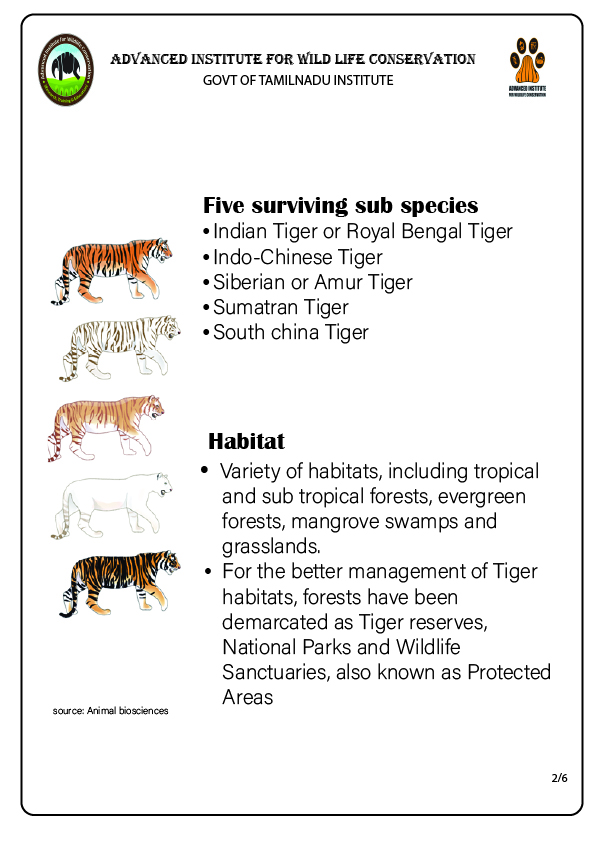
Tigers are one of the iconic animal species and largest extant among big cats. They are apex predators at top of the food chain as their existence benefit the forest by keeping the number of herbivores in check. Tigers are given “umbrella species” status, the protection of one species which will benefit all other species in the habitat. Tigers are territorial animals whose home range varies from as low as 20 km2 to hundreds of km2 in India. They constantly move in their home range to fulfil their needs and may move between territories for reproduction and during dispersal of young tigers. According to Mammal species of the World, tigers are grouped in two sub-species - Panthera tigris tigris (Bengal, Caspian, Siberian, Indo-chinese, South-chinese and Malayan tigers) & Panthera tigris sondaica (Javan, Bali and Sumatran tigers).
The primary threat to tiger conservation is habitat loss. Around half of all 50 tiger reserves in India are facing threat by developmental activities like roads, railway lines, mining etc. There is also pressure by unregulated pilgrimage inside tiger reserves and threat to habitat by natural causes like changing climate resulting in spread of invasive plants, change in sea level in Sundarbans.
Loss of habitat for tigers drive them out of protected areas into human dominant habitat resulting in conflict with humans. This creates a negative notion among people about tigers.
Apart from habitat loss tigers have always been the target for poachers due to the demand for tiger products in south east Asian countries. Every part of tiger is used in illegal trade which has resulted in decline of tiger numbers in Asian countries while some countries have pushed tigers to extinction in recent time.
Among the 13 tiger populated countries India ranks the top in tiger population and protection, thanks to its rigorous conservation efforts since 1973. The government of India launched its “Project Tiger” initiative to revive the population of tigers in India which were in decline due to historic large-scale hunting during the colonial period and poaching and habitat destruction after India’s independence. The National Tiger Conservation Authority (NTCA) was established in December 2005 to manage project tiger and tiger reserves in India.
As per 2019 report by NTCA, India is the habitat for 75% of global tiger population with 2967 individuals in 50 tiger reserves across the country based on its 2018 All India Census. The census is conducted once in four years on pan India scale. There is a steady increase in population of tigers, 30% increase from 2014 census numbers. The increase in number of tigers is an indication that the forests are healthy and prey species are abundant in the habitat.
Tamil Nadu has four tiger reserves,
• Reintroduction of tigers in its historical habitat to expand tiger range in India, e.g., Sariska tiger reserve
• New record of tigers in high altitude Himalayan regions sheds new light on adaptability of tigers to extreme conditions proving greater scope for research in tigers
• Use of camera traps1 in mark-recapture method to accurately estimate tiger population
• Use of radio-telemetry technology to study tiger movement ecology, habitat use, and other behavioural aspects
• GIS and Remote sensing methods to assess and study tiger landscapes for creating robust management plans
• Application of robotics and drone technology for management of tiger habitats
• Anatomical studies of tiger bones and other body parts by morphometric analysis to identify and validate tiger parts in illegal trade
• Use of assignments tests involving a combination of highly polymorphic DNA markers and statistical tools to determine the geographical origin or population of a particular individual
• Microsatellite DNA based allele frequencies between samples under investigation compared with reference population give information about geographical origin of trafficked specimen. This could facilitate detection of illegal wildlife trade and detect the trade routes to focus efforts to reduce or prevent wildlife trafficking
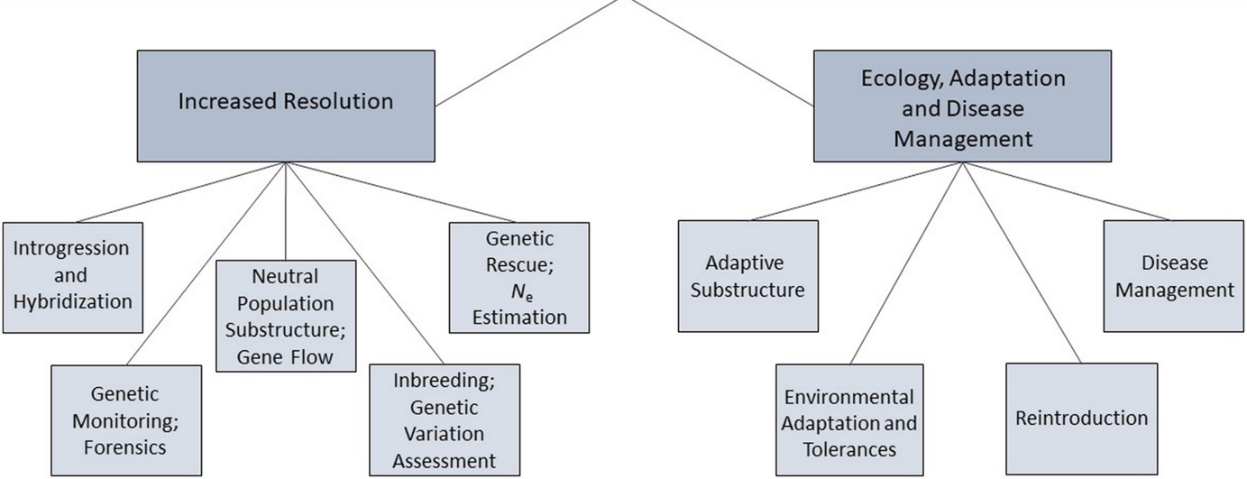
Source: Walters A.D., Schwartz M.K. (2020) Population Genomics for the Management of Wild Vertebrate Populations. In: . Population Genomics.
The 2018 all India census is significant in that it is the largest wildlife survey conducted in the world in terms of geographical coverage, intensity of survey and number of camera traps used and holds a Guinness record.